
It is one of the questions we receive most often:
“Is it better to build the foundation on screws or from concrete?”
The right answer is not that one of the solutions is always better.
A screw foundation can have an important advantage when the building allows point supports, machine access is possible, we want to reduce digging and wet works, and the screws can reach a suitable layer of ground.
A concrete foundation can be more suitable for basements, rafts, continuous foundations, heavy masonry, retaining walls or situations where the geometry of the building requires continuous infrastructure anyway.
And there are projects in which the right solution is a combination of the two: a hybrid foundation with screws and reinforced concrete.
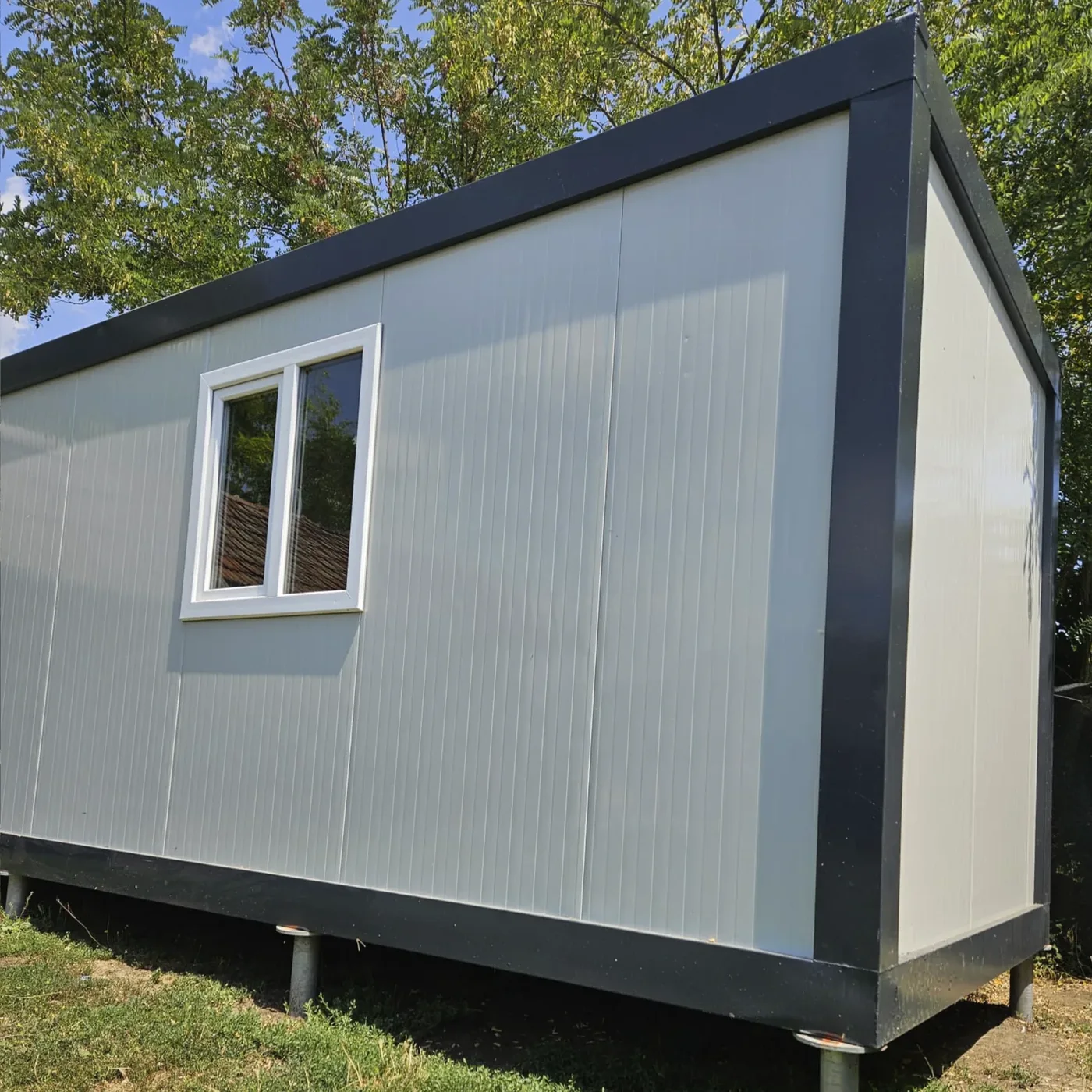
For modular houses, containers, terraces, Timber Frame, LSF and other lightweight structures, the screw foundation is worth analysing when the building can be supported at points.
For a basement, raft, heavy masonry, retaining walls or continuous supports, concrete often starts with a technical advantage.
The choice should not be made only by price or by material. Two complete foundations, capable of supporting the same building on the same site, must be compared.
What is the difference between a screw foundation and a concrete one?
Point steel supports
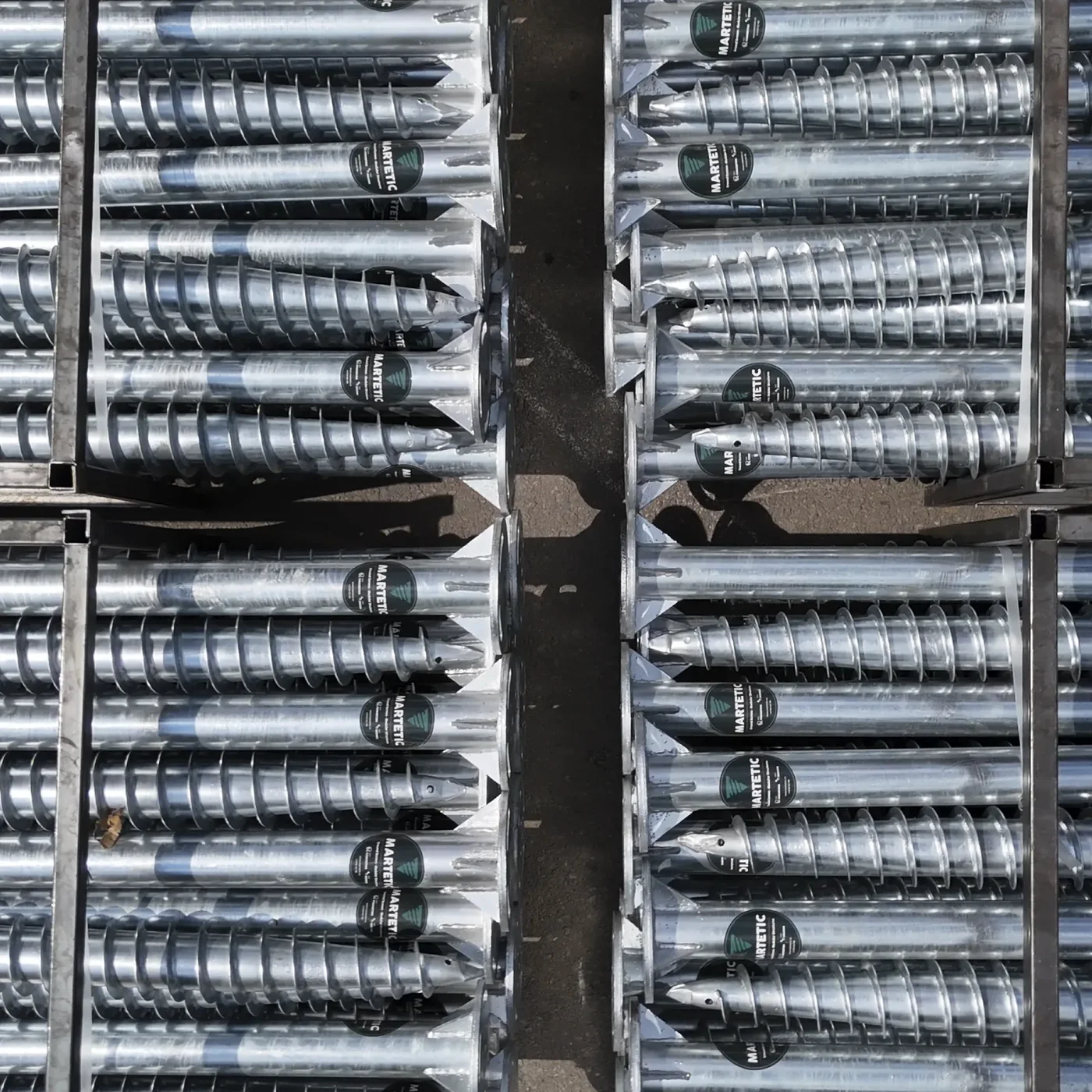
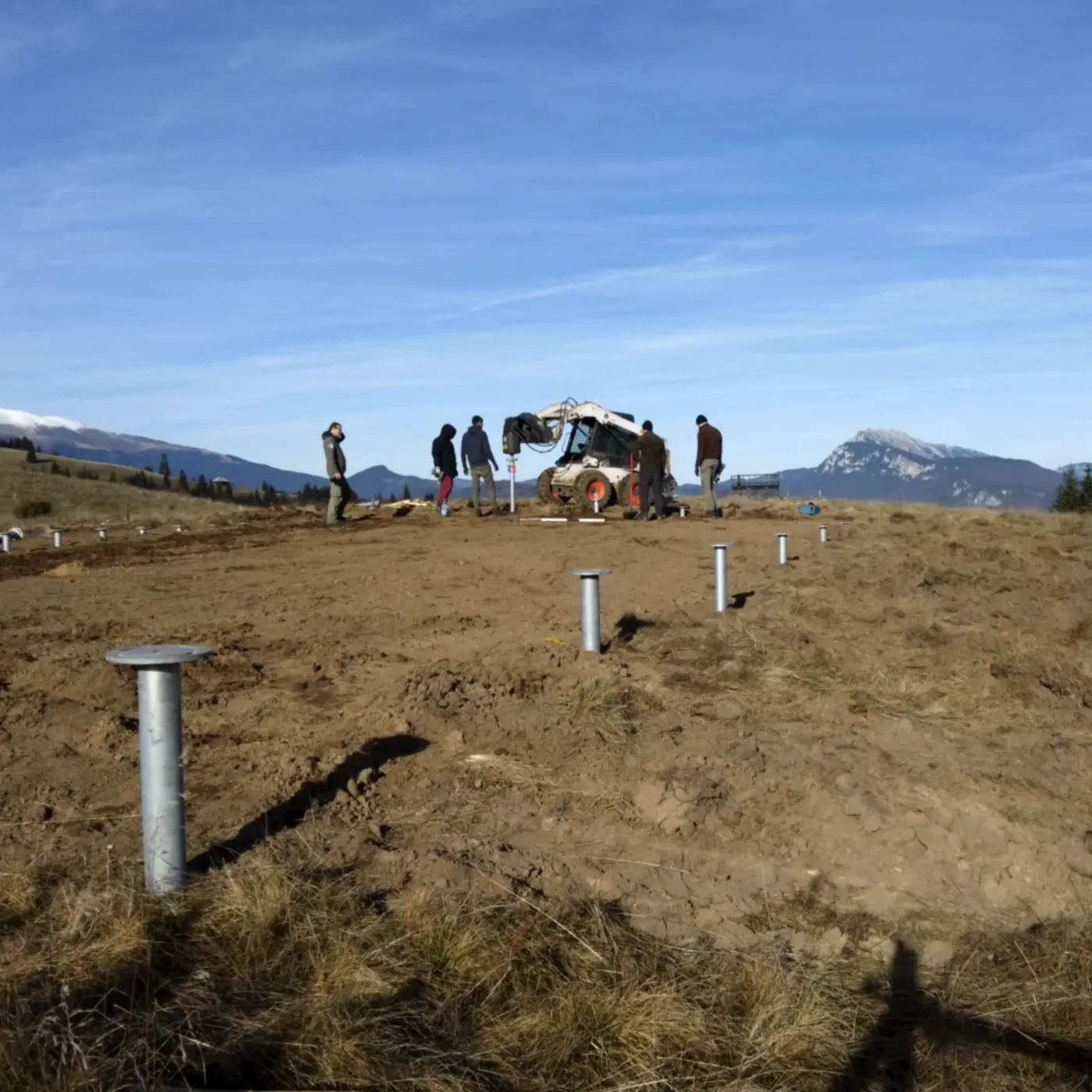
Steel elements driven into the ground by rotation, positioned where the structure needs supports. They can have fixed flanges, special connections or extensions.
Point or continuous supports
It can mean isolated foundations, pad foundations, foundation beams, continuous foundations, a raft or infrastructure with a basement.
The building's loads are transmitted through the screw to the ground, and the behaviour of the foundation must be verified according to the project's loads: compression, uplift, lateral forces and moment.
Concrete usually works together with reinforcement and transmits the loads to the ground through the surface of the foundation.
Screw foundation vs concrete: quick comparison
| Criterion | Screw foundation | Concrete foundation |
|---|---|---|
| Digging | reduced in many projects | usually necessary |
| Wet works | very low or none for the foundation | yes |
| Actual installation time | can be very short | several stages of execution |
| Curing time | none for the screw | the concrete must reach the specified strength |
| Supports | point | point or continuous |
| Sloping ground | can be advantageous | may require digging, steps or walls |
| Basement | not the usual solution | very suitable |
| Raft | no | yes |
| Dismantling | possible in certain configurations | difficult |
| Obstacles in the ground | can block screwing | can be excavated/controlled in certain situations |
| On-site testing | possible point by point | there are other methods of control and verification |
| Intervention on the ground | reduced in many projects | usually greater |
The table is indicative. The advantages of a solution can disappear if the site or the building is not suited to it.
Which foundation is cheaper?
There is no universal answer.
A screw foundation can be more economical when it eliminates or reduces digging, formwork, reinforcement, soil removal, concrete transport, the concrete pump, restoration works and waiting time.
Conversely, concrete can become more economical when the building needs continuous foundations, a raft, a basement, retaining walls or massive infrastructure anyway.
The complete screw foundation
- screws
- installation
- transport
- connecting parts
- any distribution beams
- testing
- site preparation
The complete concrete foundation
- excavation
- removal of soil
- compaction
- formwork
- reinforcement
- concrete and pump
- labour and restoration
Is a screw foundation faster?
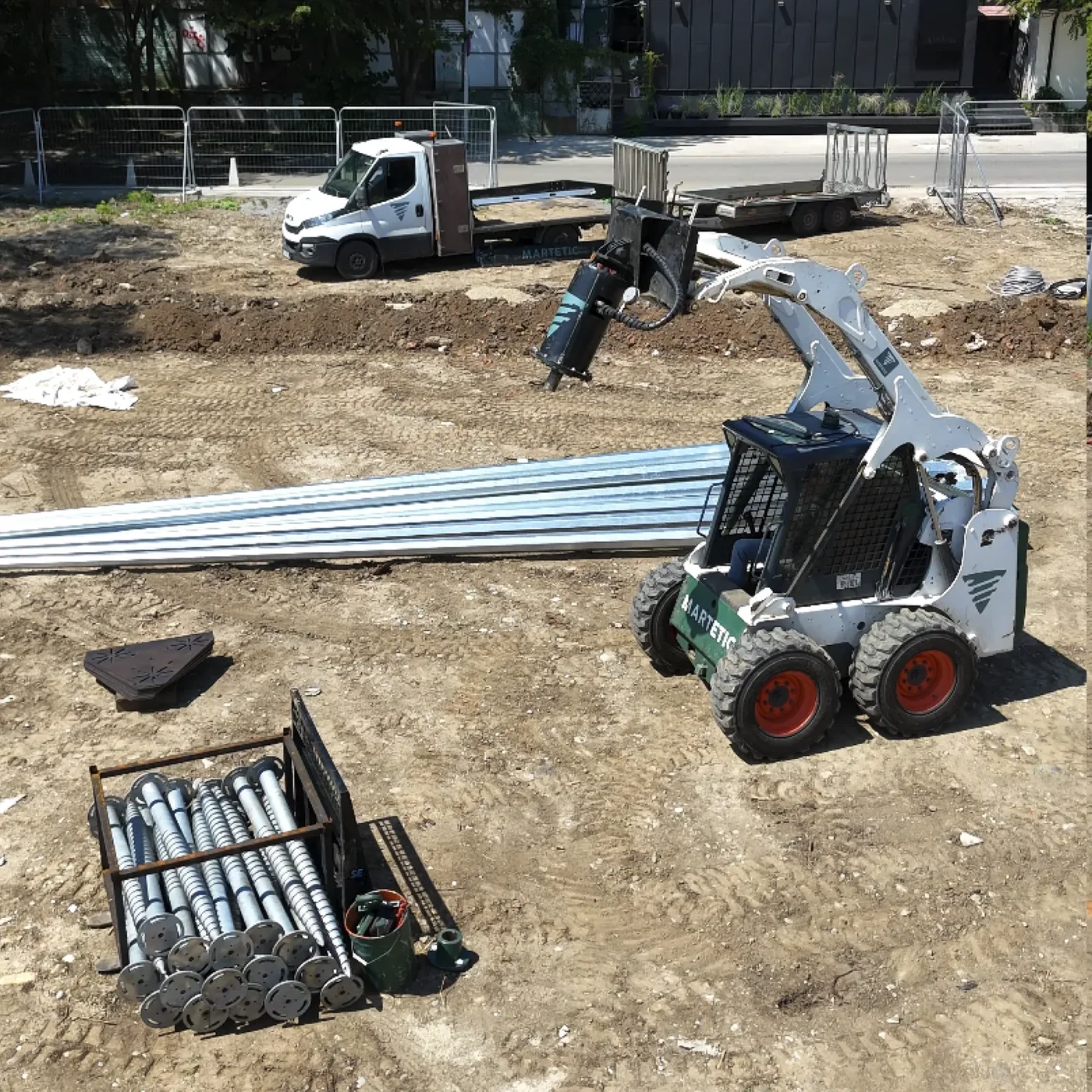
In many projects, yes. For lightweight buildings, installing the screws can take a few hours, a day or a few days, depending on the number of points and the site conditions.
Once the position, levels, verticality, connections and any checks provided for are accepted, the structure can be installed. There is no period in which the screw has to “cure”.
With concrete there are usually several stages
Preparing the footprint and excavation.
Successive stages before pouring.
The concrete must reach the specified strength.
Only then do you reach the superstructure stage.
But it is important not to confuse installation speed with the entire duration of the project. A screw foundation also has to be prepared: design, setting-out, checking access, identifying utilities, preparing the connecting parts and coordinating with the team that will install the building.
When can the time advantage of screws disappear?
- we meet boulders at many points;
- there are old foundations under the site;
- pre-drilling must be done at many positions;
- machine access is difficult;
- the special parts were not prepared;
- changes to the structure appear before or during the work;
- testing involves a separate stage.
Can the ground decide between screws and concrete?
Yes. And it is one of the most important criteria.
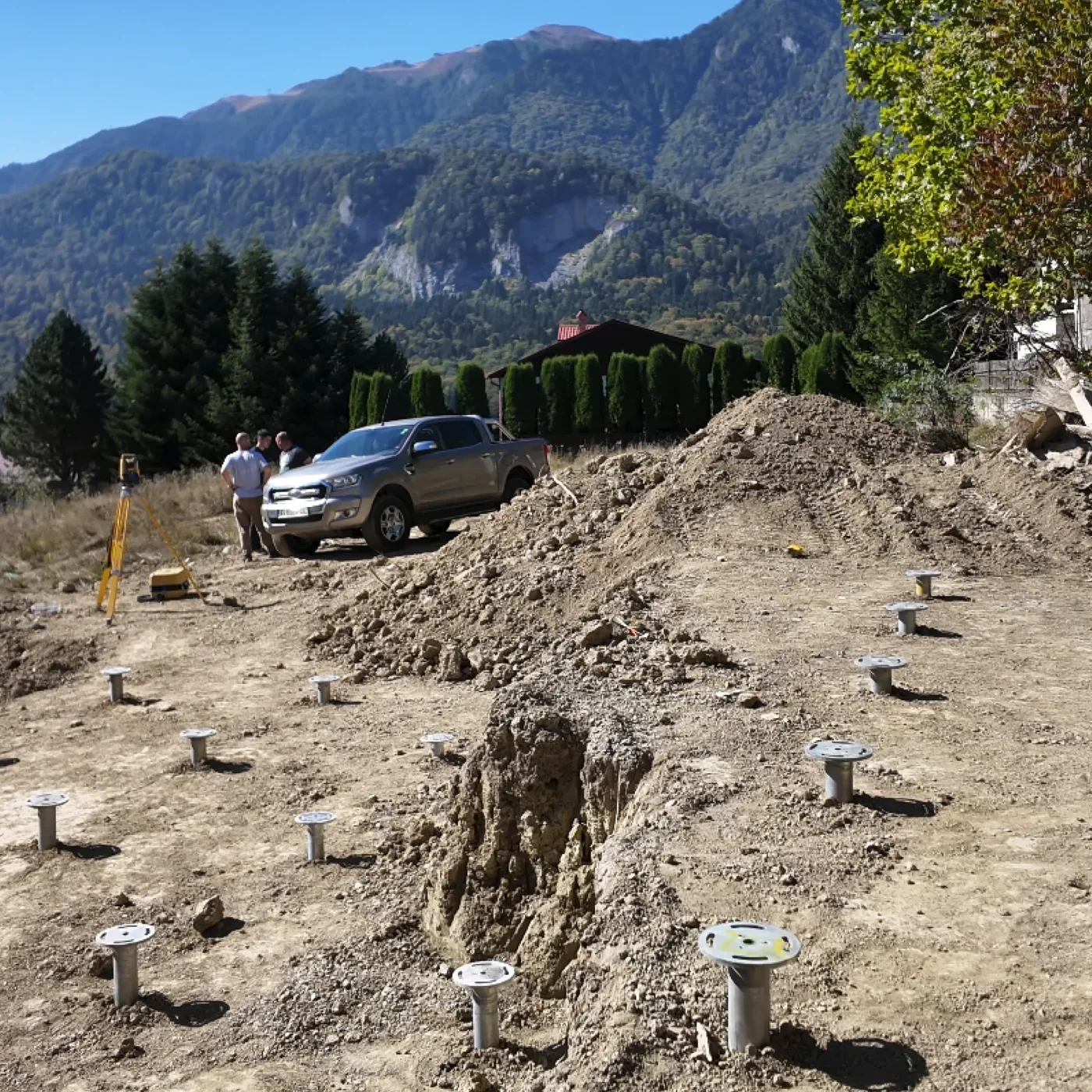
For screw foundations, the situations are generally favourable where the stratification is sufficiently known, the upper layer can be crossed and, at the required depth, there is a layer in which the product can work properly.
On the other hand, difficulties can appear when we have boulders, shallow rock, buried concrete, old foundations, fill with construction debris, significant variations in the ground, water or obstacles across much of the footprint.
In some of these situations, controlled pre-drilling, another position, another length or another system can be used. In others, concrete can become the more predictable solution.
Does meeting a stone during installation mean the ground is good?
Not necessarily. If the machine suddenly meets great resistance, it may be a dense layer, but it may also be a boulder, a piece of concrete, an old foundation or an isolated obstacle.
Forcing it to continue can deflect the screw or damage the product. The situation must be understood before drawing conclusions about the capacity of the foundation.
For the same reason, the hydraulic pressure observed at the machine is a useful installation parameter, but it must not be automatically turned into a guaranteed load-bearing capacity.
Does a lightweight building automatically mean a simple foundation?
No. The weight of the building is only part of the loads.
The weight of the building and the vertical loads push the foundation downwards.
Wind can try to lift the corners and edges of lightweight buildings.
Wind, earthquakes or other actions can load the foundation horizontally.
Posts, masts or frames can transmit significant moments at the base.
What matters is how much each point moves and the differences between points.
The loads do not reach all the points of the foundation equally.
It is not enough to say: “The house weighs 20 tonnes, so we divide 20 tonnes by the number of screws.”
When does a screw foundation have a real advantage?
They often have clear support grids and can be integrated efficiently with a point foundation.
The points can be positioned under the corners, longitudinal members and distribution beams.
The intervention in the yard can be reduced, and the foundation can adapt to level differences.
Lengths and levels can be adapted to reduce massive excavation.
In certain projects, digging and the quantity of soil removed can be reduced.
Certain configurations can be dismantled later, if the product and the connections allow.
Modular systems can allow the upper layer to be crossed in order to reach a suitable layer further down.
When is concrete more suitable?
Screws do not form the basement walls and do not solve its waterproofing. Reinforced concrete is normally the main solution to analyse.
If the project requires a continuous structural slab, a concrete raft can be the logical solution.
Some structures work more naturally with continuous foundations.
When the foundation must also take the earth pressure, reinforced concrete is usually the suitable solution to analyse.
Controlled excavation can be more predictable than installing every screw among old foundations, rubble or rock.
If the project already includes a ground slab, ramps, retaining walls and massive concrete works, the advantage of eliminating it only at the supports can be reduced.
Examples for common projects
| Project | Screw foundation to analyse | When concrete may have the advantage |
|---|---|---|
| 6 × 3 m container | M76 / M89, depending on chassis and ground | impossible access or extensive obstacles |
| Assembly of containers | M89 + distribution beams | if a continuous rigid platform is wanted |
| Modular house / LSF / Timber Frame | M89 / M114 / V89 / V114 | raft or continuous foundation if the project requires it |
| Terrace | M76 / M89 | few points and very simple digging |
| House with a basement | only special/auxiliary situations | concrete for the raft, walls and waterproofing |
| Sloping ground | different lengths / V89 / V114 | stepped foundations and retaining walls |
| Thick fill | a modular system down to the suitable layer | excavation, replacement or another foundation system |
These are examples of product families that can enter the analysis, not automatic recommendations. The final selection depends on the project and the conditions on site.
Case study: when we chose a hybrid solution
Sometimes the right question is “how can we use them together?”
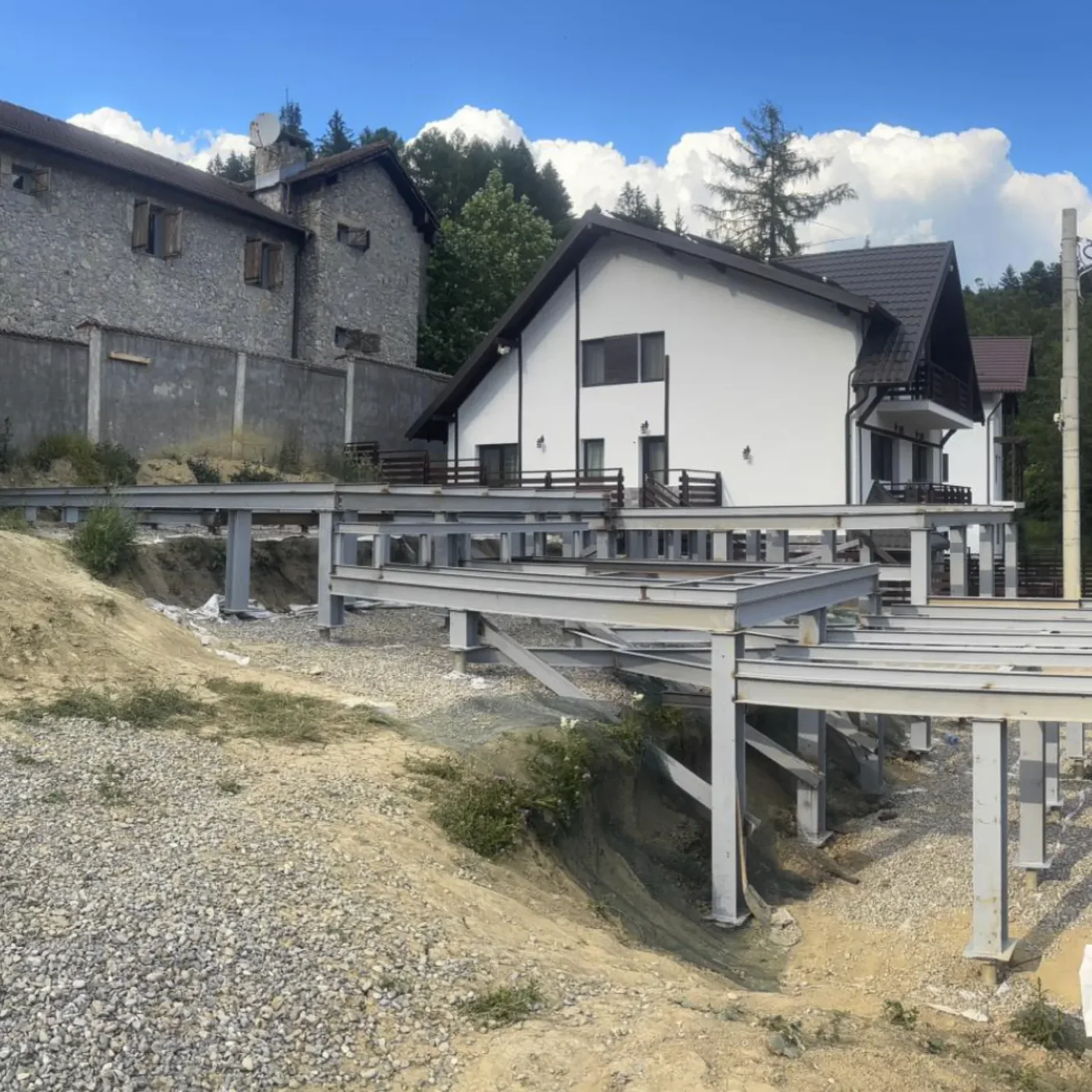
In a MARTETIC project we had a site with very limited space and several underground utilities, where conventional deep excavation was difficult.
The solution was to build hybrid pile caps. The foundation screws were driven into the ground, then integrated locally into a solution with reinforcement and concrete.
The idea was to use the advantage of the screw for transferring the loads and the advantage of reinforced concrete for creating a rigid node adapted to the building.
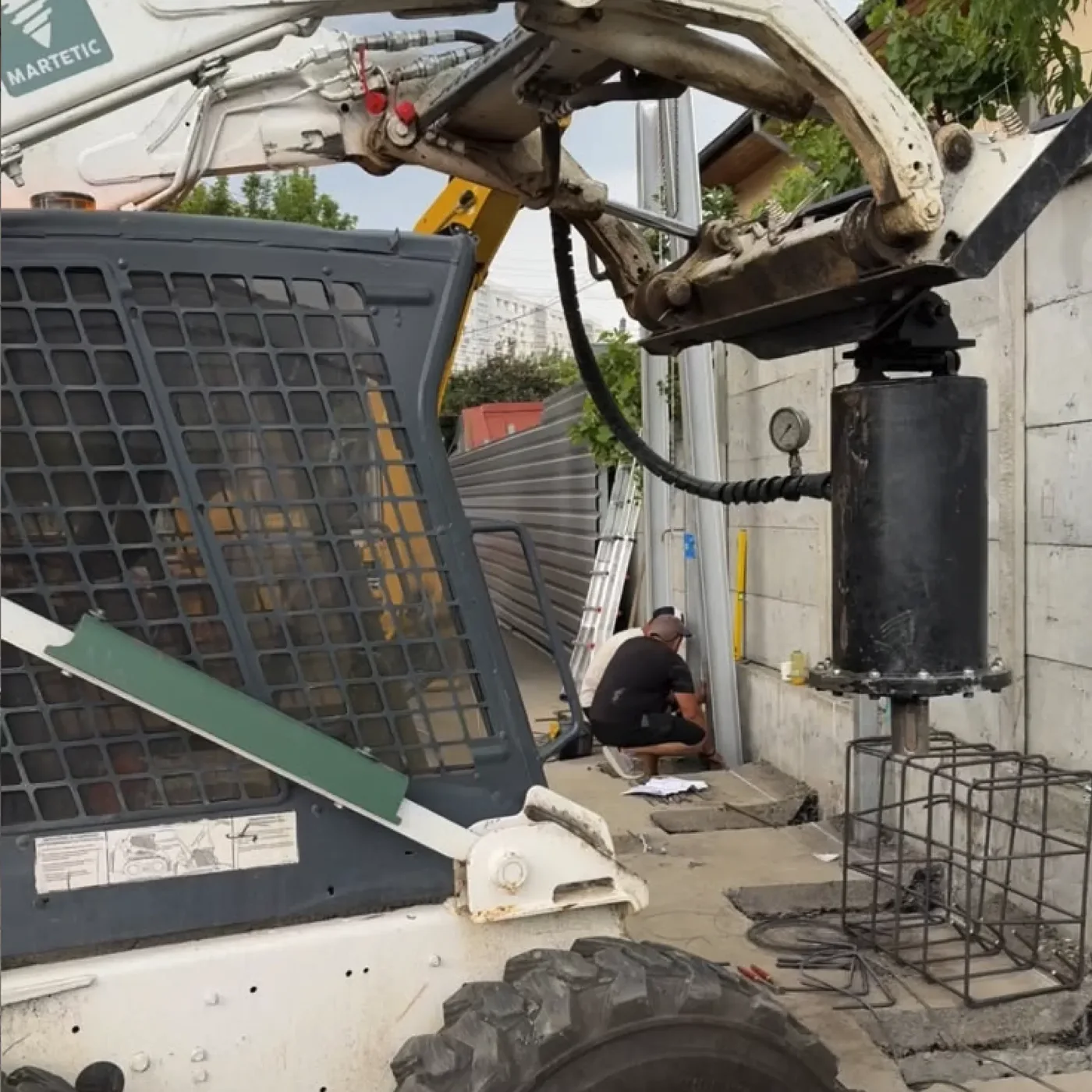
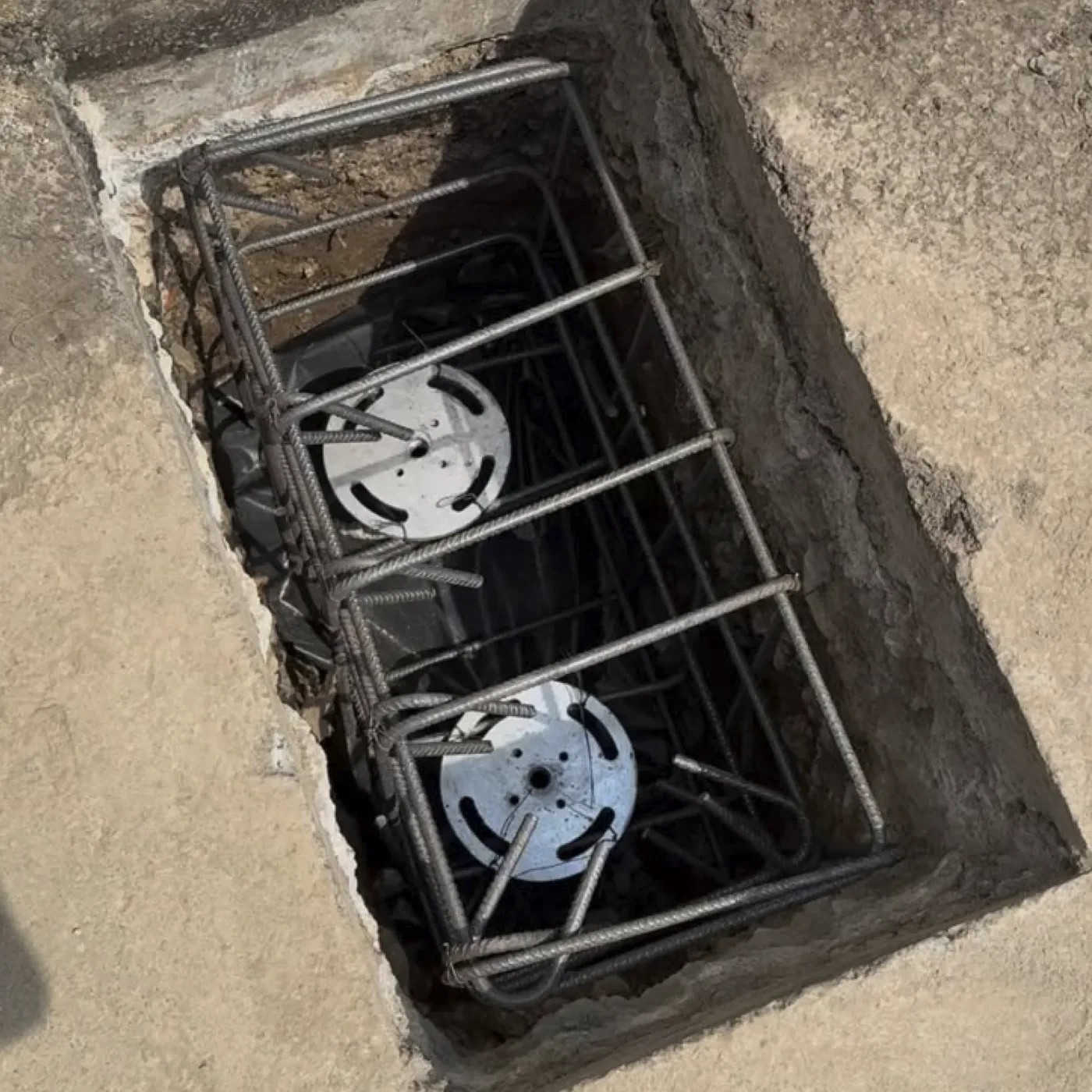
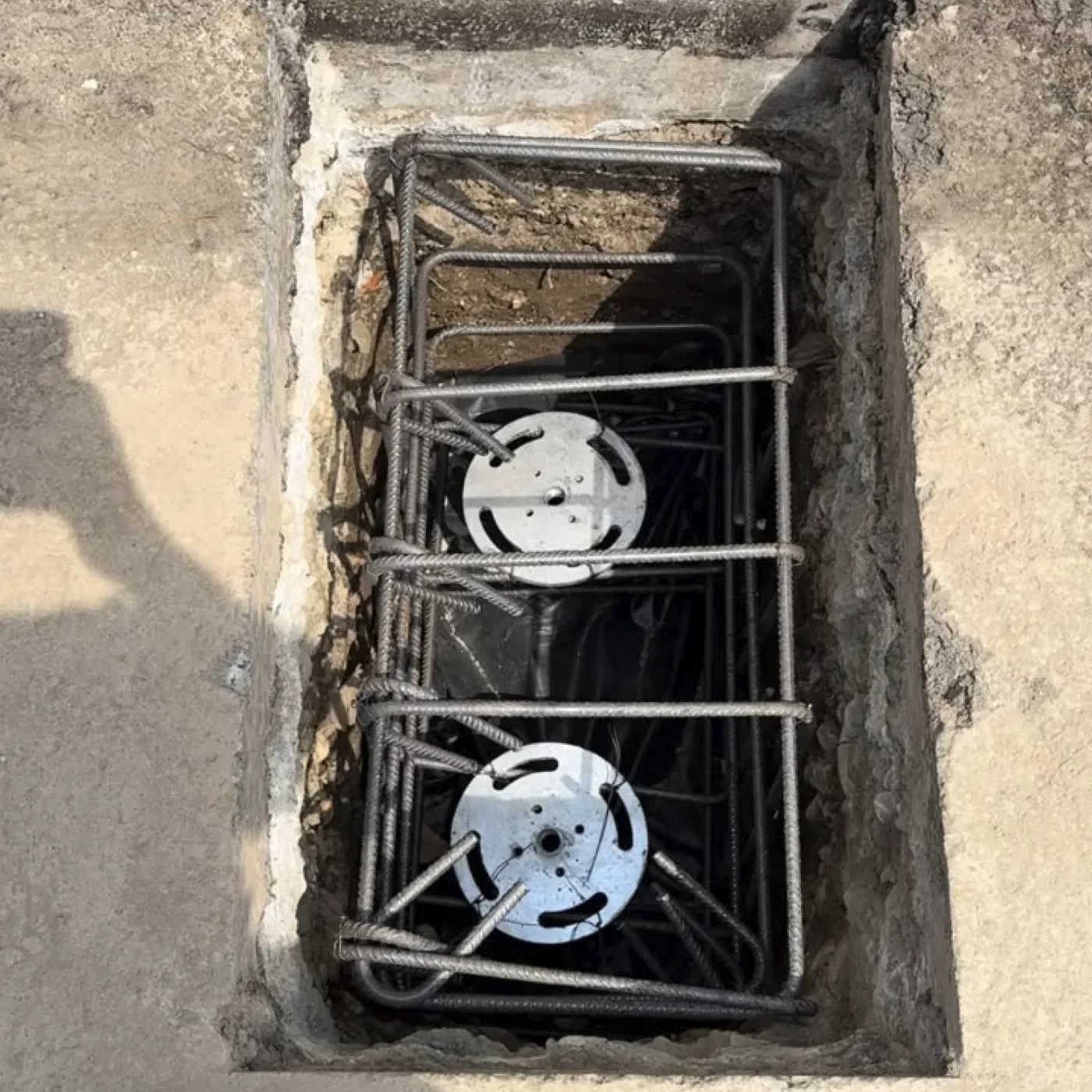
A MARTETIC example of a hybrid solution with foundation screws and reinforced concrete.
Is a screw foundation more durable than concrete?
There is no correct answer expressed only as “screws last X years, concrete lasts Y years”. Durability depends on the design, the environment, the materials and the execution.
What matters
The steel thickness, the corrosion protection, the galvanising, the aggressiveness of the ground, the water, damage caused during installation, the connections and the possibility of inspection.
What matters
The concrete class, the reinforcement, the cover to the reinforcement, the compaction, curing after pouring, water, frost, aggressive agents and the quality of execution.
Hot-dip galvanising to ISO 1461 is important, but on its own it is not a universal guarantee of lifespan in any ground. Both systems can be durable when they are designed and executed correctly.
Which foundation is better for the environment?
Screw foundations can have important advantages because they can reduce the quantity of concrete, the digging, the transport and removal of soil, the restoration works and the waste produced at decommissioning. Also, certain configurations can be dismantled.
But steel and galvanising also have a production impact. That is why it is not correct to claim that every screw foundation is automatically more ecological than every concrete foundation.
Can the building be installed immediately on screws?
In general, yes, after the foundation has been accepted.
After installation, the following must be checked, according to the project and the work: position, levels, verticality, integrity of the products, connections and any tests provided for.
After this stage there is no curing period for the screws comparable to the curing of concrete. This is one of the important advantages for modular buildings and containers, where the foundation and the delivery of the structure can be coordinated within a very short interval.
Is a concrete foundation automatically safer?
No. Just as a screw foundation is not automatically safer either.
A concrete foundation poured without suitable reinforcement, on an unsuitable bearing layer or without control of compaction does not become safe just because it is concrete.
Likewise, a large screw installed in the ground without knowing the loads and without a correct connection to the structure is not automatically a good foundation.
Do foundation screws work in any ground?
No. There are many situations in which the screw foundation works very well. There are also situations in which installation is difficult, needs another configuration or is simply not the right solution.
Boulders, shallow rock, old foundations, buried concrete, uncontrolled fill and water conditions can fundamentally change the solution.
Do screws eliminate concrete completely?
In many projects, the foundation itself can be built without concrete. But that does not mean that every building on screws must be completely free of concrete.
There may be a ground slab, a pavement, a ramp, a local pile cap, a retaining wall or another element of the building that requires concrete. And there are situations in which a hybrid solution is actually the right choice.
How do we choose between a screw foundation and concrete?
Before we compare the two options, we need some information.
Plan, dimensions, height regime, building system and reactions if available.
Geotechnical study, water, fill, slope and site conditions.
Access, utilities, existing foundations, deadline and any later dismantling.
Ideally there should be the architectural plan, the structural or foundation plan if available, the dimensions, the height regime, the building system, the weight or reactions of the structure, the geotechnical study, information about water, photographs of the site, machine access, the slope, underground utilities, existing foundations, the execution deadline and the need for any later dismantling.
After that we compare safety, complete cost, duration, access, execution risk, necessary documents and behaviour in service. No single criterion should decide the solution on its own.
Frequently asked questions
Conclusion: screws or concrete?
If we have a modular house, a container, a terrace, a Timber Frame, SIP or LSF building or a lightweight structure, the screw foundation is worth analysing.
It can reduce digging, site time and the intervention on the site, and in many projects it allows fast installation of the structure.
If we have a basement, a raft, heavy masonry, retaining walls, continuous supports or extensive obstacles in the ground, a concrete foundation may be the more logical solution.
And sometimes the right answer is a hybrid foundation.
Do you have a project and don't know whether to choose screws or concrete?
Send us the building plan, the dimensions, the locality, a few photographs of the site and the geotechnical study, if there is one. We can analyse whether a screw foundation, a hybrid solution or the classic concrete foundation is worth discussing.
Send the project for analysis