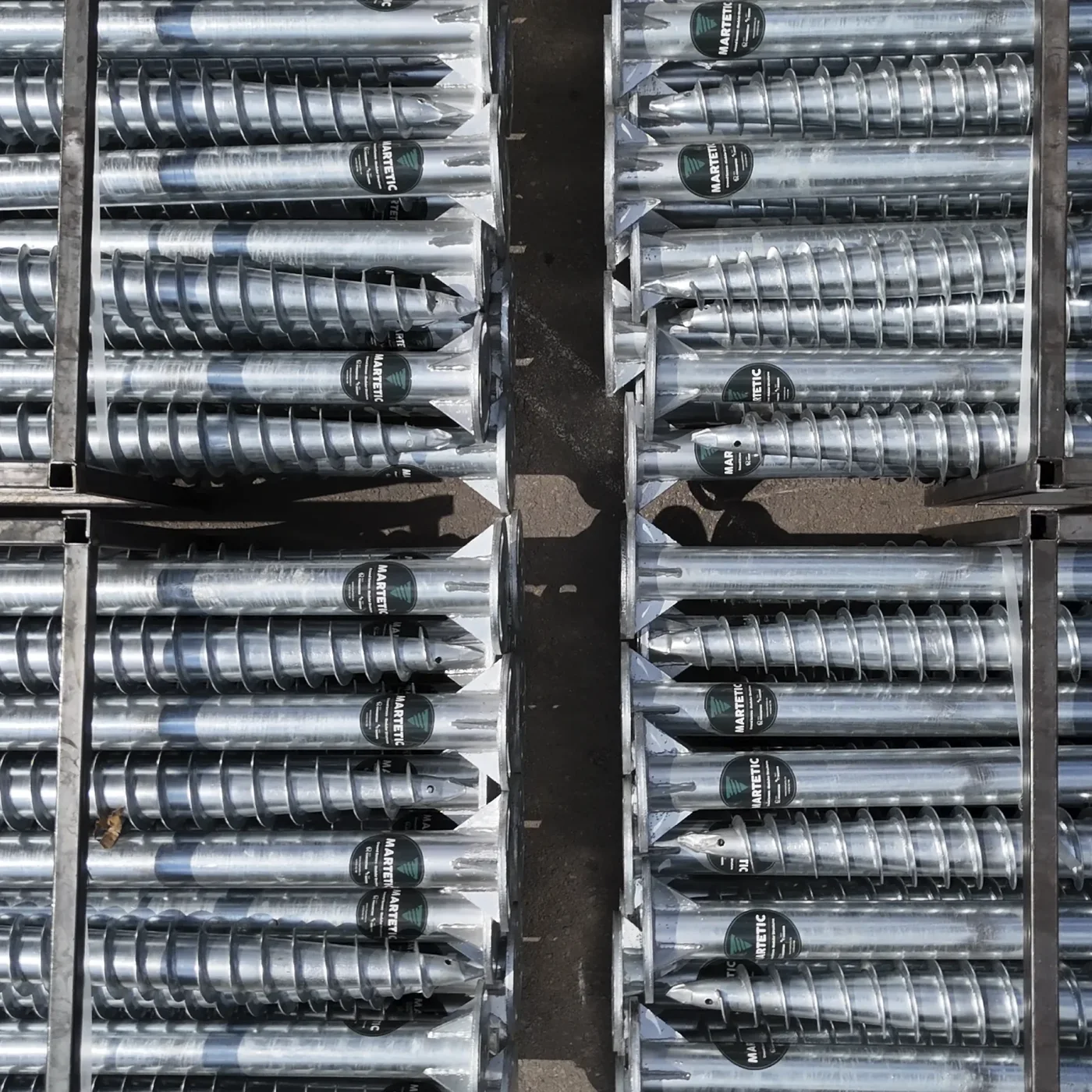
It is one of the natural questions when a steel foundation is going to support a house, a container or another permanent building:
“If the screw is in the ground, how long does it last?”
The answer cannot be reduced to a single figure.
A foundation screw that is well chosen, manufactured, protected and installed can be part of a building designed for long-term use. For ordinary buildings, structural design frequently uses a benchmark of 50 years for the design working life, but this does not mean that every foundation screw automatically has a “50-year guarantee”, nor that it becomes unusable after that period.
Real durability depends on several things that must be looked at together:
the steel thickness, the galvanising, the welds, the ground, the water, the drainage, the aggressiveness of the environment, the condition of the product after installation and the loads on the structure.
Foundation screws can be used for permanent buildings, but there is no universal lifespan valid for every product and every ground.
Hot-dip galvanising is the first protection of the steel, but the lifespan of the foundation is not determined only by the thickness of the zinc layer.
For a permanent building, the life required by the project, the environment in which the foundation works, the initial thickness of the steel and the section that remains available over time must be analysed.
is too simple for a real technical problem.
What does “50 years” actually mean?
Confusion frequently appears here.
There are at least three different things:
| Concept | What it means |
|---|---|
| Design working life | the period for which the structure is verified under the conditions provided for |
| Commercial warranty | the commitment offered by the manufacturer or seller under the terms of the warranty certificate |
| Actual lifespan | the period during which the foundation continues in reality to meet the structure's requirements |
The three values do not have to be identical.
For example, a commercial warranty of 10 years does not mean the product will work for only 10 years.
At the same time, the fact that a building is designed for a service life of 50 years does not automatically mean that every component receives a 50-year commercial warranty.
They are different concepts.
A foundation screw is not just a steel tube
When we discuss durability, the whole product must be analysed.
A foundation screw can include:
- the tubular body
- the thread or helical blade
- the tip
- the flange
- the gussets
- the welds
- the connecting bolts
- any extensions and couplings.
All these components must keep their structural role over time.
For example, the body of the screw may have sufficient thickness, but a poorly made connection or an area where water permanently stagnates can become the sensitive point of the system.
That is why we analyse the foundation as an assembly, not just the diameter of the tube.
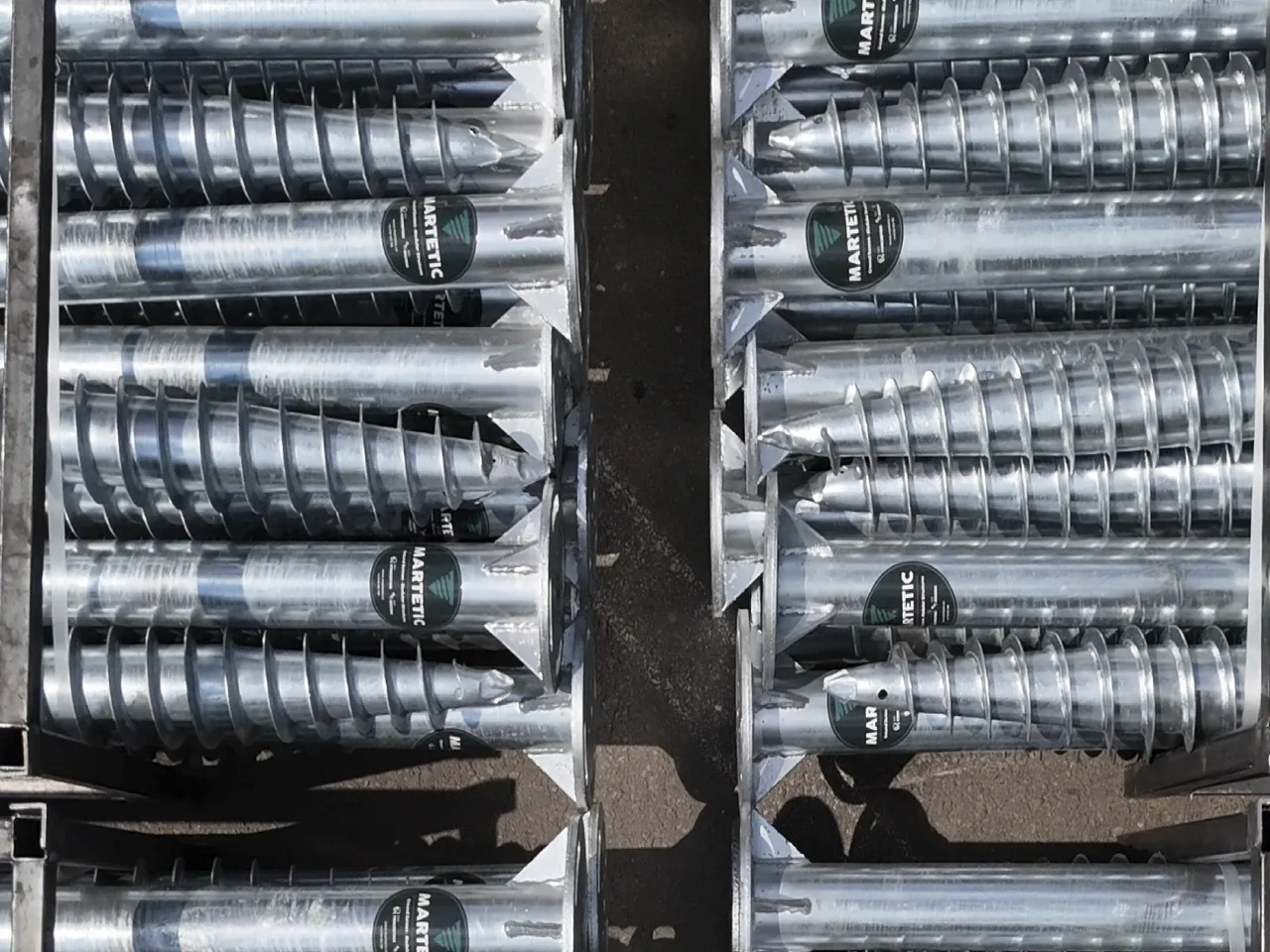
How are MARTETIC screws protected against corrosion?
MARTETIC foundation screws in the documented ranges are protected by hot-dip galvanising in accordance with EN ISO 1461, depending on the product and the related documentation.
In hot-dip galvanising, the fabricated part is immersed in a bath of molten zinc.
Metallurgical layers form between the zinc and the steel, over which a zinc-rich outer layer remains.
This protection works in two ways.
The zinc separates the steel from the external environment.
Zinc is more electrochemically active than steel and is consumed preferentially around small local defects, protecting the exposed steel.
That does not mean, however, that zinc is indestructible.
And this is where one of the most frequent misinterpretations appears.
Does ISO 1461 guarantee a certain service life?
No.
ISO 1461 sets requirements and verification methods for coatings obtained by hot-dip galvanising.
It is very important for the quality and control of the protection.
The lifespan depends on the environment in which the product works.
A screw installed in natural, well-drained ground must not automatically be treated the same as one installed in contaminated industrial fill or in an area with saline water.
Do all MARTETIC screws have 82 μm of zinc?
It should not be generalised.
In MARTETIC's technical documentation there are products for which the confirmed drawings mention a coating of 82 μm. A documented example is M Ø76 × 3.6 × 2,000 mm.
But this value must be tied to the specific product and drawing.
just because the products are hot-dip galvanised.
For each model, the documentation of that product and batch must be checked.
Can we convert the zinc thickness directly into years?
Not responsibly.
It looks tempting to do a simple calculation:
But for an element buried in the ground, the problem is much more complex.
The corrosion rate is not the same:
- in natural, well-drained ground
- in fill
- in permanently wet ground
- in an area with a variable water level
- at a site with salts
- in an industrial environment.
Even along the length of the same screw there can be different exposure zones.
That is why the zinc thickness is an important parameter, but it cannot be turned into a universal lifespan by a simple division.
What influences the corrosion of a steel pile in the ground?
The ground is not a uniform environment.
Two neighbours can have different conditions even if they are in the same locality.
Important factors include:
Natural, relatively uniform soils tend to offer more predictable conditions than heterogeneous fill.
Water takes part in the electrochemical corrosion processes.
Variation in the water level can create alternations between wet and aerated zones.
Strongly acidic or alkaline environments can change the behaviour of the protection.
They can come from salts, water, industrial activities or certain fill.
Ash, slag, demolition debris or other materials can form environments much more aggressive than natural ground.
Near certain electrical installations or infrastructure, additional corrosion mechanisms can appear.
Under certain conditions galvanic corrosion can occur.
This is why the right question is not only:
“What environment will it work in?”
The zone at ground level is important
We often think that the most exposed part is the one deepest down.
Not always.
The zone where the screw passes from the ground into the air can be repeatedly subjected to:
- wetting and drying
- mud
- vegetation
- salt
- impacts
- water running off the building
- later changes to the ground level.
For this reason, a good detail must avoid, as far as possible, the permanent accumulation of water and must allow the accessible parts of the foundation to be inspected.
If after installation the ground level is raised, drainage is blocked or a permanently wet area is created around the screw, the exposure conditions change from those for which the work was carried out.
Natural ground and fill are not the same thing
It is a very important difference.
A fill can contain:
- soil
- sand
- clay
- gravel
- concrete
- brick
- ash
- slag
- construction debris
- unknown materials.
From a structural point of view, these influence the capacity and the settlement.
From a durability point of view, they can change the water, the aeration and the chemistry of the environment.
That is why, in a fill of unknown origin, it is not enough to say:
Resistance during installation and chemical aggressiveness are two different problems.
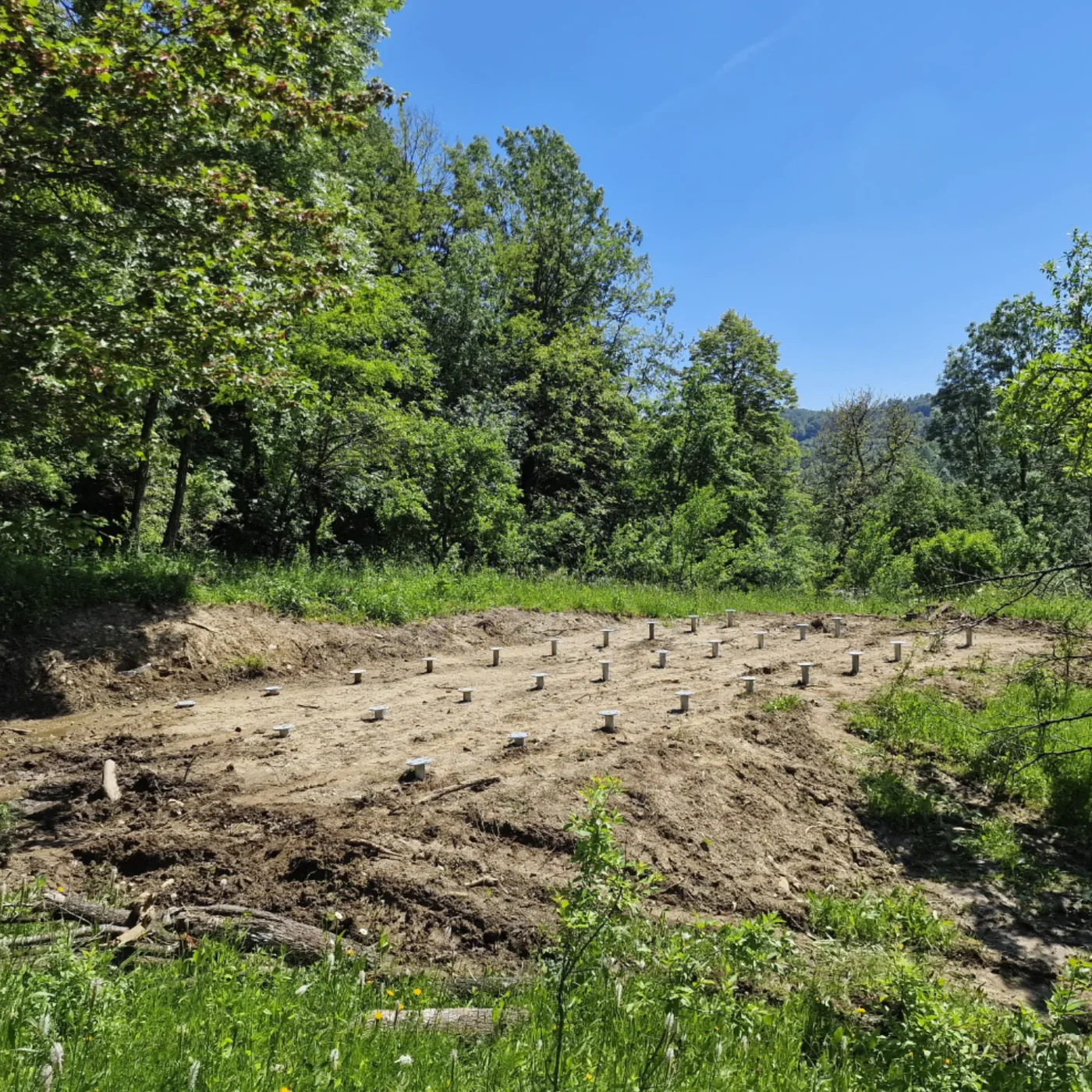
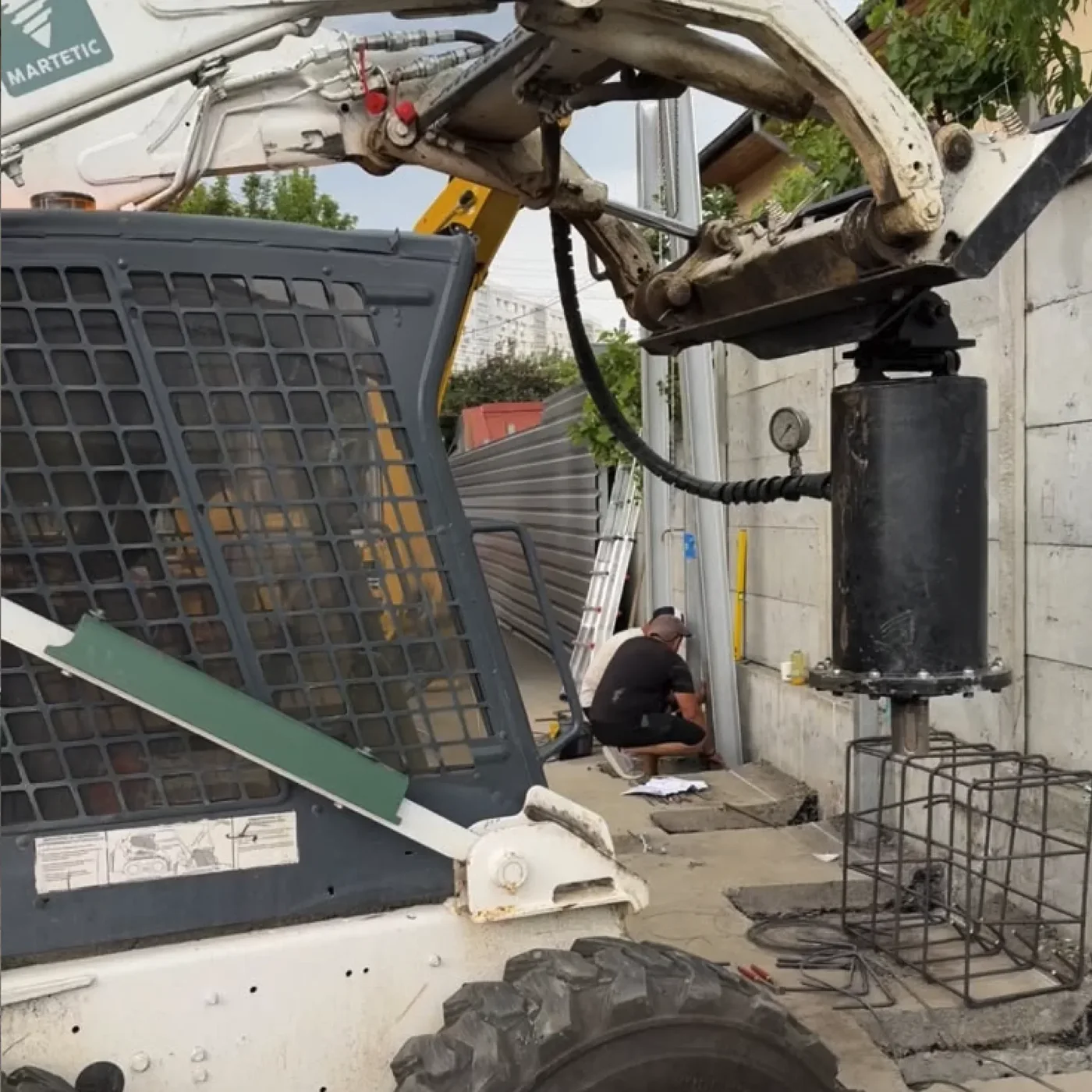
How is durability designed?
For a permanent building, the logic matters more than a commercial promise.
The process can be summarised like this:
- the service life required of the building is set
- the exact model of the screw is identified
- the diameter, thickness, material, welds and geometry are checked
- the corrosion protection is checked
- the ground and the water are analysed
- the material loss relevant to the project is estimated
- it is checked whether the remaining section can still take the loads
- any additional measures and inspections are set.
In practice, we are not interested only in how the screw looks on the day of installation.
We are interested in whether, after the degradation allowed for in the calculation, enough material remains for the foundation to fulfil its structural role.
What does EN 1993-5 say about loss of thickness?
The Eurocode for steel piles gives indicative thickness-loss values in different environments.
They do not represent a guarantee for a MARTETIC product and are not used directly for quoting, but they are very useful for understanding how much the environment matters.
As an educational example:
| Environment | Indicative loss at 50 years |
|---|---|
| Undisturbed natural ground – sand, silt, clay, etc. | 0.60 mm |
| Aggressive natural ground – peat, marsh, etc. | 1.75 mm |
| Aggressive uncompacted fill – ash, slag, etc. | 3.25 mm |
The difference is very large.
That is exactly why we cannot take a single screw and say it has the same lifespan at any site.
Why does the steel thickness matter?
Let's take a simplified example, only to understand the principle.
Suppose a tubular body with an initial thickness of:
and, for the example, we give no credit to the zinc.
If we use the indicative benchmark of 0.60 mm loss at 50 years for undisturbed natural ground, geometrically there would remain:
That 3.0 mm must then be checked structurally.
In an aggressive fill, if the benchmark were 3.25 mm, the same part would be in a completely different situation.
The example does not size a MARTETIC product.
It only shows why:
Does a 4.5 mm screw automatically last longer than a 3.6 mm one?
Not automatically, although a greater thickness in principle offers a larger reserve of material.
The following must also be analysed:
- the diameter
- the loads
- buckling
- the thread geometry
- the welds
- the length
- the environment
- the corrosion protection.
A thicker product does not automatically compensate for a wrong selection or an environment it was not designed for.
What does MARTETIC do for the durability of the foundation?
Durability starts with correctly identifying the product.
Depending on the project, the following ranges can be analysed:
G, M, V or Custom configurations.
The products have different diameters, thicknesses, lengths, flanges and geometries.
For the documented models, MARTETIC uses structural steel and hot-dip galvanising in accordance with the product documentation, and the selection must be correlated with the site and the life required of the building.
For ordinary environments, the documented standard configuration may be suitable.
For:
- unknown fill
- peat
- ash
- slag
- industrial environments
- saline water
- areas with high concentrations of salts
- stray currents
additional investigations, different thicknesses, additional protection or even another foundation system may be needed.
And it is important to say this before installation, not after problems appear.
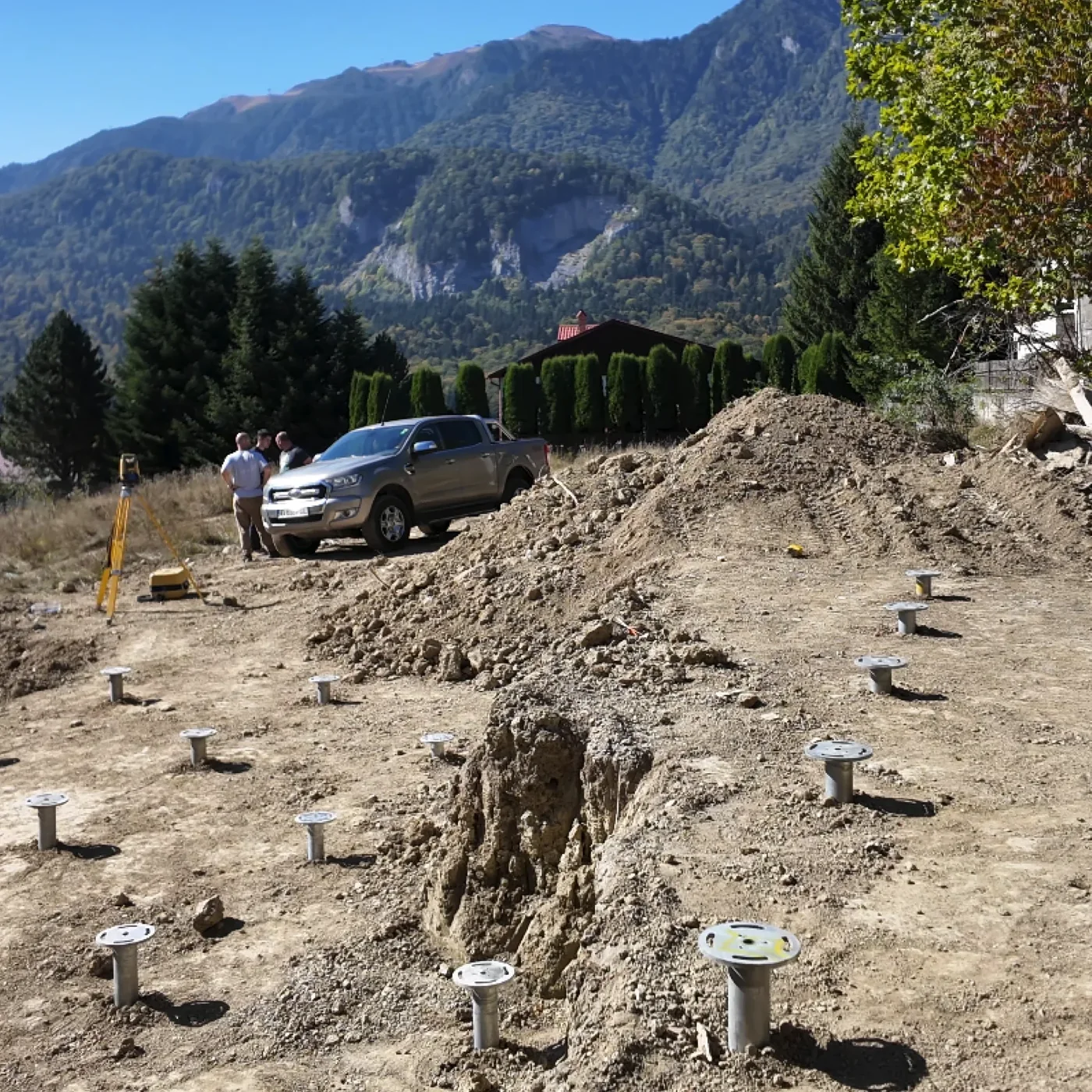
What role does traceability play?
Traceability does not physically prevent corrosion from appearing.
But without it we do not know exactly which product we are analysing.
The client must be able to identify, as applicable:
- the model
- the batch
- the manufacturer
- the dimensions
- the material
- the product documentation
- the corrosion protection.
Depending on the product and the contract, MARTETIC documentation can include a data sheet, a declaration of performance, a CE label, documents relating to the manufacturing system, information about galvanising, traceability, the installation documents and contracted test reports.
A screw without clear identification cannot be assessed responsibly just because it “looks the same”.
Can installation affect service life?
Yes.
Durability can be compromised even before the product enters the ground.
For example:
- permanent storage in water
- improper handling
- striking the thread
- deforming the blade
- damaging the zinc
- cutting
- drilling
- welding after galvanising without an adequate restoration procedure.
During installation, normal superficial marks of contact with the ground can appear.
But a bent blade, a crack in a weld, a significant deformation or a large area where the protection has been removed must be assessed.
For this reason, in the article on installing foundation screws we explained why the product must be monitored and checked throughout execution.
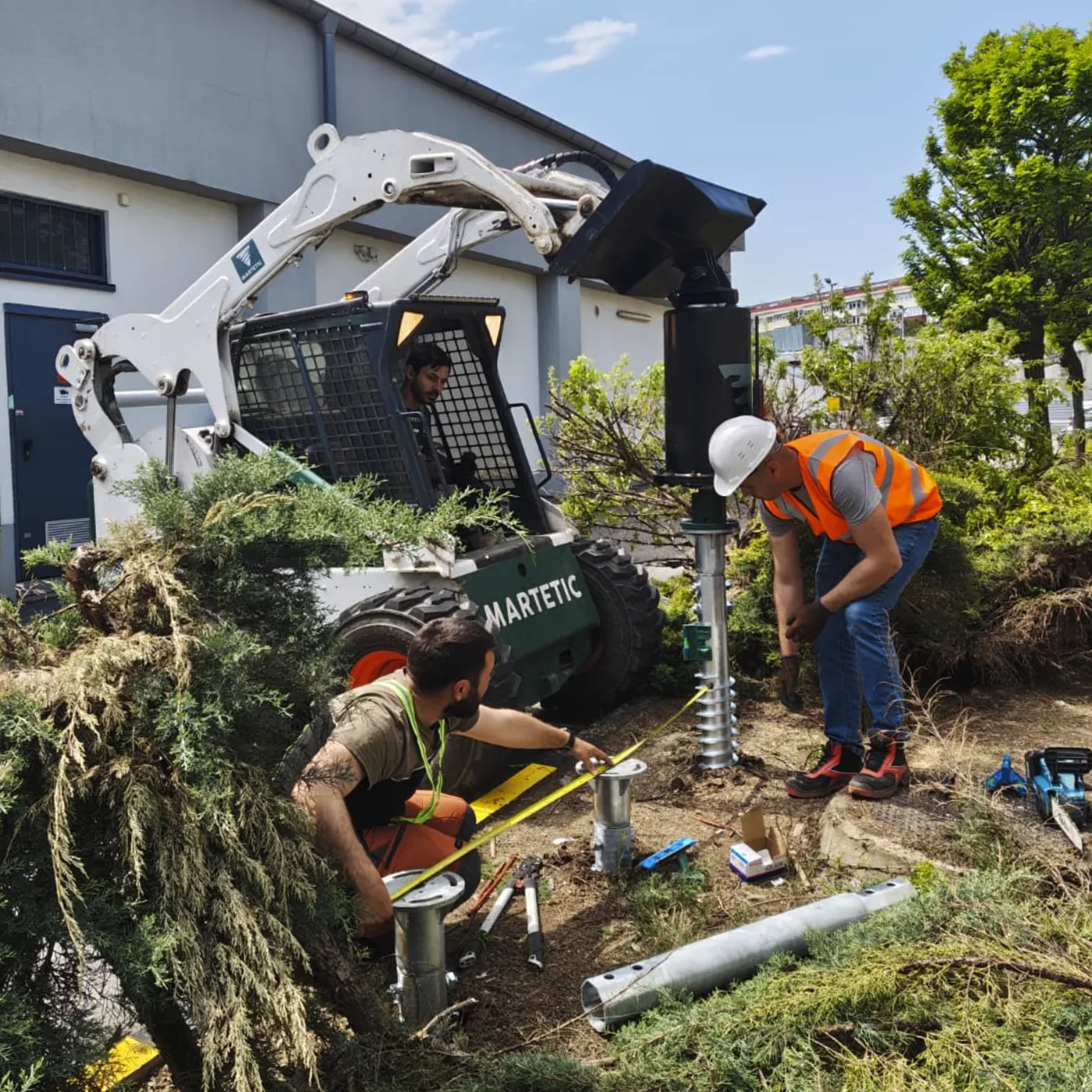
Can a galvanised screw be welded or cut after installation?
It should not be treated as an ordinary adjustment.
Cutting, drilling or welding after galvanising locally changes the corrosion protection and, in certain situations, can also change the structural behaviour.
If such an intervention is necessary, there must be:
- an approved detail
- a work method
- surface preparation
- a suitable system for restoring the protection.
For this reason, where possible, we prefer flanges, holes, gussets and other Custom elements to be defined before fabrication and galvanising.
Is the geotechnical study enough to find out whether the ground is corrosive?
Not always.
The geotechnical study provides the information needed for geotechnical design, but it does not necessarily contain all the analyses needed for a detailed corrosion assessment.
At suspect sites, analyses such as the following can become relevant:
- pH
- resistivity
- chlorides
- sulphates
- moisture
- contaminants
- other site-specific parameters.
For example, a former industrial platform or a fill with ash and slag must be viewed differently from natural ground with no history of contamination.
Do foundation screws need maintenance?
In service, most of the screw is not visible.
But that does not mean the foundation should be forgotten completely.
The client can periodically monitor the accessible areas:
- the flanges
- the connections
- the zone at ground level
- the drainage
- any settlements
- changes made to the site.
Signs worth investigating can be:
- water that stagnates permanently
- mud kept around the screw
- red corrosion
- loosened fasteners
- deformations
- changes in levels
- doors that begin to work differently
- new interventions on the ground
- floods or chemical spills.
These signs do not automatically show a problem with the foundation, but they can justify a check.
Does white rust mean the screw is compromised?
Not automatically.
On galvanised products, whitish deposits can appear, especially when galvanised parts are stored damp and without sufficient air circulation.
A superficial mark does not automatically mean loss of structural function.
The situation must be assessed by its extent and condition.
Red rust, on the other hand, shows that the steel is exposed in a certain area and is worth investigating.
We will deal with this subject separately in the dedicated guide:
so as not to overload this article with all the corrosion mechanisms.
How can the part in the ground be checked?
Not by a simple visual inspection.
If there are real grounds for suspicion, methods such as the following can be considered:
- controlled local excavation
- thickness measurement
- analysis of the ground
- inspection of the interior where the geometry allows
- specialised measurements
- structural verification.
The method must be chosen according to the specific problem.
Does uplift testing tell how many years the screw will last?
No.
Axial testing and durability verification answer different questions.
A compression or uplift test shows the behaviour of the foundation under load at the time of the test.
It does not directly measure the thickness of the zinc layer and cannot on its own say how many years the product will last.
Durability is analysed through:
When may standard galvanising not be enough?
For many applications, hot-dip galvanising is a robust protection.
But there are environments in which additional measures may be needed.
Depending on the project, the following can be considered:
- additional steel thickness
- duplex zinc + paint systems
- local protections
- cathodic protection in special applications
- other materials
- another foundation solution.
The choice must be made before installation, after analysing the environment.
What lasts longer: a screw foundation or concrete?
The question is too general for an “A” or “B” answer.
Reinforced concrete also has its own degradation mechanisms:
- cracking
- carbonation
- reinforcement corrosion
- chloride ingress
- sulphate attack
- freeze-thaw
- problems caused by execution or drainage.
A well-designed concrete foundation can have a long life.
So can a steel screw foundation.
The right choice is made according to the building, ground, environment, cost and the possibility of design and control.
For the complete comparison you can consult:
Screw foundation or concrete?
Myths about the lifespan of foundation screws
Zinc protects the steel and slows corrosion, but the protection depends on the environment and can be consumed.
The layer thickness is important, but it cannot be turned into a number of years without knowing the real environment.
It is not a rule.
The visible appearance is useful, but it does not automatically describe the condition of the entire buried part.
Thickness helps, but it must be correlated with the loads and the environment.
They are two different things.
What should the client ask for?
If the screws are going to support a permanent building, don't ask only:
It is useful to also know:
- the exact model
- the diameter
- the wall thickness
- the material
- the thread geometry
- the flange and the welds
- the corrosion protection
- the product documents
- the batch and traceability
- how the foundation was installed
- any checks and tests.
And, very importantly:
Frequently asked questions
How many years does a foundation screw last?
There is no universal number. For ordinary buildings it can be designed for a service life of 50 years or more, but the product must be checked for ground, water, steel thickness, corrosion protection and loads. In favourable conditions it can remain functional longer. In aggressive environments it may need additional protection or another solution.
Can MARTETIC foundation screws be used for a permanent house?
Yes, when the configuration is set for the project and is compatible with the structure, the ground and the required service life. The fact that a certain model exists in the catalogue does not automatically make it suitable for any house.
Does hot-dip galvanising guarantee 50 years?
No. Galvanising is an important component of corrosion protection. The real lifespan also depends on the ground, water, steel thickness and design.
Do all MARTETIC screws have 82 μm?
No. The value must be checked for the specific product and documentation.
Do foundation screws rust?
Zinc can be consumed over time, and steel can corrode if it becomes exposed. The rate varies greatly from one environment to another.
What is the most sensitive area?
In many situations, the zone near ground level deserves attention because it can repeatedly go through wet-dry cycles and can accumulate water, mud or salts.
Does the geotechnical study show whether the ground is corrosive?
It may contain useful information, but not always all the analyses needed for a corrosion assessment. At certain sites, additional investigations may be needed.
Can paint be applied over zinc?
Yes, duplex systems exist, but the materials and the surface preparation must be compatible.
Does uplift testing prove service life?
No. It shows the behaviour under load at the time of the test, not the estimated life of the corrosion protection.
Conclusion: so how long do they last?
Foundation screws can be part of permanent buildings designed for long-term use.
But their lifespan cannot be demonstrated by a single figure, nor by the simple statement:
A correct technical answer takes into account:
In ordinary conditions, a well-designed and executed foundation can support the building for the service life provided for in the project.
In aggressive environments, the conclusion can be different: a more robust product, additional protection, monitoring or even another foundation system.
At MARTETIC we prefer to say this clearly rather than promise the same number of years for any screw installed in any ground.
Do you have a project for a permanent building?
Send us the building plan, the locality, the geotechnical study if there is one and information about the site.
We can analyse the product, the length, the ground conditions, the installation and the documentation needed for your project's foundation.
Send the project for analysis